


Tag Archives: Arthur Bailey
Hebrews 11
Hebrews 11
Great Examples of Faith
1 Faith shows the reality of what we hope for; it is the evidence of things we cannot see.2 Through their faith, the people in days of old earned a good reputation.
3 By faith we understand that the entire universe was formed at God’s command, that what we now see did not come from anything that can be seen.
4 It was by faith that Abel brought a more acceptable offering to God than Cain did. Abel’s offering gave evidence that he was a righteous man, and God showed his approval of his gifts. Although Abel is long dead, he still speaks to us by his example of faith.
5 It was by faith that Enoch was taken up to heaven without dying—“he disappeared, because God took him.”[a] For before he was taken up, he was known as a person who pleased God. 6 And it is impossible to please God without faith. Anyone who wants to come to him must believe that God exists and that he rewards those who sincerely seek him.
7 It was by faith that Noah built a large boat to save his family from the flood. He obeyed God, who warned him about things that had never happened before. By his faith Noah condemned the rest of the world, and he received the righteousness that comes by faith.
8 It was by faith that Abraham obeyed when God called him to leave home and go to another land that God would give him as his inheritance. He went without knowing where he was going. 9 And even when he reached the land God promised him, he lived there by faith—for he was like a foreigner, living in tents. And so did Isaac and Jacob, who inherited the same promise. 10 Abraham was confidently looking forward to a city with eternal foundations, a city designed and built by God.
11 It was by faith that even Sarah was able to have a child, though she was barren and was too old. She believed[b] that God would keep his promise. 12 And so a whole nation came from this one man who was as good as dead—a nation with so many people that, like the stars in the sky and the sand on the seashore, there is no way to count them.
13 All these people died still believing what God had promised them. They did not receive what was promised, but they saw it all from a distance and welcomed it. They agreed that they were foreigners and nomads here on earth. 14 Obviously people who say such things are looking forward to a country they can call their own. 15 If they had longed for the country they came from, they could have gone back. 16 But they were looking for a better place, a heavenly homeland. That is why God is not ashamed to be called their God, for he has prepared a city for them.
17 It was by faith that Abraham offered Isaac as a sacrifice when God was testing him. Abraham, who had received God’s promises, was ready to sacrifice his only son, Isaac,18 even though God had told him, “Isaac is the son through whom your descendants will be counted.”[c] 19 Abraham reasoned that if Isaac died, God was able to bring him back to life again. And in a sense, Abraham did receive his son back from the dead.
20 It was by faith that Isaac promised blessings for the future to his sons, Jacob and Esau.
21 It was by faith that Jacob, when he was old and dying, blessed each of Joseph’s sons and bowed in worship as he leaned on his staff.
22 It was by faith that Joseph, when he was about to die, said confidently that the people of Israel would leave Egypt. He even commanded them to take his bones with them when they left.
23 It was by faith that Moses’ parents hid him for three months when he was born. They saw that God had given them an unusual child, and they were not afraid to disobey the king’s command.
24 It was by faith that Moses, when he grew up, refused to be called the son of Pharaoh’s daughter. 25 He chose to share the oppression of God’s people instead of enjoying the fleeting pleasures of sin. 26 He thought it was better to suffer for the sake of Christ than to own the treasures of Egypt, for he was looking ahead to his great reward. 27 It was by faith that Moses left the land of Egypt, not fearing the king’s anger. He kept right on going because he kept his eyes on the one who is invisible. 28 It was by faith that Moses commanded the people of Israel to keep the Passover and to sprinkle blood on the doorposts so that the angel of death would not kill their firstborn sons.
29 It was by faith that the people of Israel went right through the Red Sea as though they were on dry ground. But when the Egyptians tried to follow, they were all drowned.
30 It was by faith that the people of Israel marched around Jericho for seven days, and the walls came crashing down.
31 It was by faith that Rahab the prostitute was not destroyed with the people in her city who refused to obey God. For she had given a friendly welcome to the spies.
32 How much more do I need to say? It would take too long to recount the stories of the faith of Gideon, Barak, Samson, Jephthah, David, Samuel, and all the prophets. 33 By faith these people overthrew kingdoms, ruled with justice, and received what God had promised them. They shut the mouths of lions, 34 quenched the flames of fire, and escaped death by the edge of the sword. Their weakness was turned to strength. They became strong in battle and put whole armies to flight. 35 Women received their loved ones back again from death.
But others were tortured, refusing to turn from God in order to be set free. They placed their hope in a better life after the resurrection. 36 Some were jeered at, and their backs were cut open with whips. Others were chained in prisons. 37 Some died by stoning, some were sawed in half,[d] and others were killed with the sword. Some went about wearing skins of sheep and goats, destitute and oppressed and mistreated. 38 They were too good for this world, wandering over deserts and mountains, hiding in caves and holes in the ground.
39 All these people earned a good reputation because of their faith, yet none of them received all that God had promised. 40 For God had something better in mind for us, so that they would not reach perfection without us.
Hebrew 9
Hebrews 9
Old Rules about Worship
1 That first covenant between God and Israel had regulations for worship and a place of worship here on earth. 2 There were two rooms in that Tabernacle.[a] In the first room were a lampstand, a table, and sacred loaves of bread on the table. This room was called the Holy Place. 3 Then there was a curtain, and behind the curtain was the second room[b] called the Most Holy Place. 4 In that room were a gold incense altar and a wooden chest called the Ark of the Covenant, which was covered with gold on all sides. Inside the Ark were a gold jar containing manna, Aaron’s staff that sprouted leaves, and the stone tablets of the covenant.5 Above the Ark were the cherubim of divine glory, whose wings stretched out over the Ark’s cover, the place of atonement. But we cannot explain these things in detail now.
6 When these things were all in place, the priests regularly entered the first room[c] as they performed their religious duties. 7 But only the high priest ever entered the Most Holy Place, and only once a year. And he always offered blood for his own sins and for the sins the people had committed in ignorance. 8 By these regulations the Holy Spirit revealed that the entrance to the Most Holy Place was not freely open as long as the Tabernacle[d] and the system it represented were still in use.
9 This is an illustration pointing to the present time. For the gifts and sacrifices that the priests offer are not able to cleanse the consciences of the people who bring them. 10 For that old system deals only with food and drink and various cleansing ceremonies—physical regulations that were in effect only until a better system could be established.
Christ Is the Perfect Sacrifice
11 So Christ has now become the High Priest over all the good things that have come.[e] He has entered that greater, more perfect Tabernacle in heaven, which was not made by human hands and is not part of this created world. 12 With his own blood—not the blood of goats and calves—he entered the Most Holy Place once for all time and secured our redemption forever.
13 Under the old system, the blood of goats and bulls and the ashes of a heifer could cleanse people’s bodies from ceremonial impurity. 14 Just think how much more the blood of Christ will purify our consciences from sinful deeds[f] so that we can worship the living God. For by the power of the eternal Spirit, Christ offered himself to God as a perfect sacrifice for our sins. 15 That is why he is the one who mediates a new covenant between God and people, so that all who are called can receive the eternal inheritance God has promised them. For Christ died to set them free from the penalty of the sins they had committed under that first covenant.
16 Now when someone leaves a will,[g] it is necessary to prove that the person who made it is dead.[h] 17 The will goes into effect only after the person’s death. While the person who made it is still alive, the will cannot be put into effect.
18 That is why even the first covenant was put into effect with the blood of an animal. 19 For after Moses had read each of God’s commandments to all the people, he took the blood of calves and goats,[i] along with water, and sprinkled both the book of God’s law and all the people, using hyssop branches and scarlet wool. 20 Then he said, “This blood confirms the covenant God has made with you.”[j] 21 And in the same way, he sprinkled blood on the Tabernacle and on everything used for worship. 22 In fact, according to the law of Moses, nearly everything was purified with blood. For without the shedding of blood, there is no forgiveness.
23 That is why the Tabernacle and everything in it, which were copies of things in heaven, had to be purified by the blood of animals. But the real things in heaven had to be purified with far better sacrifices than the blood of animals.
24 For Christ did not enter into a holy place made with human hands, which was only a copy of the true one in heaven. He entered into heaven itself to appear now before God on our behalf. 25 And he did not enter heaven to offer himself again and again, like the high priest here on earth who enters the Most Holy Place year after year with the blood of an animal. 26 If that had been necessary, Christ would have had to die again and again, ever since the world began. But now, once for all time, he has appeared at the end of the age[k] to remove sin by his own death as a sacrifice.
27 And just as each person is destined to die once and after that comes judgment, 28 so also Christ was offered once for all time as a sacrifice to take away the sins of many people. He will come again, not to deal with our sins, but to bring salvation to all who are eagerly waiting for him.
Footnotes:
- 9:2 Or tent; also in 9:11, 21.
- 9:3 Greek second tent.
- 9:6 Greek first tent.
- 9:8 Or the first room; Greek reads the first tent.
- 9:11 Some manuscripts read that are about to come.
- 9:14 Greek from dead works.
- 9:16a Or covenant; also in 9:17.
- 9:16b Or Now when someone makes a covenant, it is necessary to ratify it with the death of a sacrifice.
- 9:19 Some manuscripts do not include and goats.
- 9:20 Exod 24:8.
- 9:26 Greek the ages.
Bible Sabbath Fellowship Friday May 4th 2018 @ 10pm est
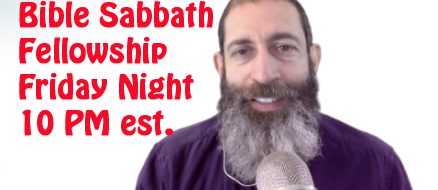
Host Paul Nison and 9 other guest fellowship and discuss Torah related topics.
Support Joseph Israel’s family
https://www.gofundme.com/joseph-israel
If you would like to be on the panel email me at the website http://www.TorahLifeMinistries.org contact tab.
The Torah Portion for this week
Torah Portion #30
K’doshim (Leviticus 19:1-20:27)
https://youtu.be/oXRg8-OO7c4
Hebrews 6
Hebrews 6
1 So let us stop going over the basic teachings about Christ again and again. Let us go on instead and become mature in our understanding. Surely we don’t need to start again with the fundamental importance of repenting from evil deeds[a] and placing our faith in God. 2 You don’t need further instruction about baptisms, the laying on of hands, the resurrection of the dead, and eternal judgment. 3 And so, God willing, we will move forward to further understanding.
4 For it is impossible to bring back to repentance those who were once enlightened—those who have experienced the good things of heaven and shared in the Holy Spirit, 5 who have tasted the goodness of the word of God and the power of the age to come— 6 and who then turn away from God. It is impossible to bring such people back to repentance; by rejecting the Son of God, they themselves are nailing him to the cross once again and holding him up to public shame.
7 When the ground soaks up the falling rain and bears a good crop for the farmer, it has God’s blessing. 8 But if a field bears thorns and thistles, it is useless. The farmer will soon condemn that field and burn it.
9 Dear friends, even though we are talking this way, we really don’t believe it applies to you. We are confident that you are meant for better things, things that come with salvation. 10 For God is not unjust. He will not forget how hard you have worked for him and how you have shown your love to him by caring for other believers,[b] as you still do. 11 Our great desire is that you will keep on loving others as long as life lasts, in order to make certain that what you hope for will come true. 12 Then you will not become spiritually dull and indifferent. Instead, you will follow the example of those who are going to inherit God’s promises because of their faith and endurance.
God’s Promises Bring Hope
13 For example, there was God’s promise to Abraham. Since there was no one greater to swear by, God took an oath in his own name, saying:
14 “I will certainly bless you,
and I will multiply your descendants beyond number.”[c]
15 Then Abraham waited patiently, and he received what God had promised.
16 Now when people take an oath, they call on someone greater than themselves to hold them to it. And without any question that oath is binding. 17 God also bound himself with an oath, so that those who received the promise could be perfectly sure that he would never change his mind. 18 So God has given both his promise and his oath. These two things are unchangeable because it is impossible for God to lie. Therefore, we who have fled to him for refuge can have great confidence as we hold to the hope that lies before us. 19 This hope is a strong and trustworthy anchor for our souls. It leads us through the curtain into God’s inner sanctuary. 20 Jesus has already gone in there for us. He has become our eternal High Priest in the order of Melchizedek.
Hebrews 5
Hebrews 5
1 Every high priest is a man chosen to represent other people in their dealings with God. He presents their gifts to God and offers sacrifices for their sins. 2 And he is able to deal gently with ignorant and wayward people because he himself is subject to the same weaknesses.3 That is why he must offer sacrifices for his own sins as well as theirs.
4 And no one can become a high priest simply because he wants such an honor. He must be called by God for this work, just as Aaron was. 5 That is why Christ did not honor himself by assuming he could become High Priest. No, he was chosen by God, who said to him,
“You are my Son.
Today I have become your Father.[a]”
6 And in another passage God said to him,
“You are a priest forever in the order of Melchizedek.”[b]
7 While Jesus was here on earth, he offered prayers and pleadings, with a loud cry and tears, to the one who could rescue him from death. And God heard his prayers because of his deep reverence for God. 8 Even though Jesus was God’s Son, he learned obedience from the things he suffered. 9 In this way, God qualified him as a perfect High Priest, and he became the source of eternal salvation for all those who obey him. 10 And God designated him to be a High Priest in the order of Melchizedek.
A Call to Spiritual Growth
11 There is much more we would like to say about this, but it is difficult to explain, especially since you are spiritually dull and don’t seem to listen. 12 You have been believers so long now that you ought to be teaching others. Instead, you need someone to teach you again the basic things about God’s word.[c] You are like babies who need milk and cannot eat solid food. 13 For someone who lives on milk is still an infant and doesn’t know how to do what is right. 14 Solid food is for those who are mature, who through training have the skill to recognize the difference between right and wrong.
Footnotes:
Hebrews 2
Hebrews 2
A Warning against Drifting Away
1 So we must listen very carefully to the truth we have heard, or we may drift away from it.2 For the message God delivered through angels has always stood firm, and every violation of the law and every act of disobedience was punished. 3 So what makes us think we can escape if we ignore this great salvation that was first announced by the Lord Jesus himself and then delivered to us by those who heard him speak? 4 And God confirmed the message by giving signs and wonders and various miracles and gifts of the Holy Spirit whenever he chose.
Jesus, the Man
5 And furthermore, it is not angels who will control the future world we are talking about. 6 For in one place the Scriptures say,
“What are mere mortals that you should think about them,
or a son of man[a] that you should care for him?
7 Yet for a little while you made them a little lower than the angels
and crowned them with glory and honor.[b]
8 You gave them authority over all things.”[c]
Now when it says “all things,” it means nothing is left out. But we have not yet seen all things put under their authority. 9 What we do see is Jesus, who for a little while was given a position “a little lower than the angels”; and because he suffered death for us, he is now “crowned with glory and honor.” Yes, by God’s grace, Jesus tasted death for everyone.10 God, for whom and through whom everything was made, chose to bring many children into glory. And it was only right that he should make Jesus, through his suffering, a perfect leader, fit to bring them into their salvation.
11 So now Jesus and the ones he makes holy have the same Father. That is why Jesus is not ashamed to call them his brothers and sisters.[d] 12 For he said to God,
“I will proclaim your name to my brothers and sisters.
I will praise you among your assembled people.”[e]
13 He also said,
“I will put my trust in him,”
that is, “I and the children God has given me.”[f]
14 Because God’s children are human beings—made of flesh and blood—the Son also became flesh and blood. For only as a human being could he die, and only by dying could he break the power of the devil, who had[g] the power of death. 15 Only in this way could he set free all who have lived their lives as slaves to the fear of dying.
16 We also know that the Son did not come to help angels; he came to help the descendants of Abraham. 17 Therefore, it was necessary for him to be made in every respect like us, his brothers and sisters,[h] so that he could be our merciful and faithful High Priest before God. Then he could offer a sacrifice that would take away the sins of the people. 18 Since he himself has gone through suffering and testing, he is able to help us when we are being tested.
Bible Sabbath Fellowship Friday April 27th 2018 @ 10pm est
Host Paul Nison and 9 other guest fellowship and discuss Torah related topics.
Support Joseph Israel’s family https://www.gofundme.com/joseph-israel
If you would like to be on the panel email me at the website http://www.TorahLifeMinistries.org contact tab.
The Torah Portion for this week
Torah Portion #29
Acharei Mot (Leviticus 16:1-18:30)
https://youtu.be/jA7J4inZMrE
Deuteronomy 34
Deuteronomy 34
The Death of Moses
1 Then Moses went up to Mount Nebo from the plains of Moab and climbed Pisgah Peak, which is across from Jericho. And the Lord showed him the whole land, from Gilead as far as Dan; 2 all the land of Naphtali; the land of Ephraim and Manasseh; all the land of Judah, extending to the Mediterranean Sea[a]; 3 the Negev; the Jordan Valley with Jericho—the city of palms—as far as Zoar. 4 Then the Lord said to Moses, “This is the land I promised on oath to Abraham, Isaac, and Jacob when I said, ‘I will give it to your descendants.’ I have now allowed you to see it with your own eyes, but you will not enter the land.”
5 So Moses, the servant of the Lord, died there in the land of Moab, just as the Lord had said.6 The Lord buried him[b] in a valley near Beth-peor in Moab, but to this day no one knows the exact place. 7 Moses was 120 years old when he died, yet his eyesight was clear, and he was as strong as ever. 8 The people of Israel mourned for Moses on the plains of Moab for thirty days, until the customary period of mourning was over.
9 Now Joshua son of Nun was full of the spirit of wisdom, for Moses had laid his hands on him. So the people of Israel obeyed him, doing just as the Lord had commanded Moses.
10 There has never been another prophet in Israel like Moses, whom the Lord knew face to face. 11 The Lord sent him to perform all the miraculous signs and wonders in the land of Egypt against Pharaoh, and all his servants, and his entire land. 12 With mighty power, Moses performed terrifying acts in the sight of all Israel.
Deuteronomy 33
Deuteronomy 33
Moses Blesses the People
1 This is the blessing that Moses, the man of God, gave to the people of Israel before his death:
2 “The Lord came from Mount Sinai
and dawned upon us[a] from Mount Seir;
he shone forth from Mount Paran
and came from Meribah-kadesh
with flaming fire at his right hand.[b]
3 Indeed, he loves his people;[c]
all his holy ones are in his hands.
They follow in his steps
and accept his teaching.
4 Moses gave us the Lord’s instruction,
the special possession of the people of Israel.[d]
5 The Lord became king in Israel[e]—
when the leaders of the people assembled,
when the tribes of Israel gathered as one.”
6 Moses said this about the tribe of Reuben:[f]
“Let the tribe of Reuben live and not die out,
though they are few in number.”
7 Moses said this about the tribe of Judah:
“O Lord, hear the cry of Judah
and bring them together as a people.
Give them strength to defend their cause;
help them against their enemies!”
8 Moses said this about the tribe of Levi:
“O Lord, you have given your Thummim and Urim—the sacred lots—
to your faithful servants the Levites.[g]
You put them to the test at Massah
and struggled with them at the waters of Meribah.
9 The Levites obeyed your word
and guarded your covenant.
They were more loyal to you
than to their own parents.
They ignored their relatives
and did not acknowledge their own children.
10 They teach your regulations to Jacob;
they give your instructions to Israel.
They present incense before you
and offer whole burnt offerings on the altar.
11 Bless the ministry of the Levites, O Lord,
and accept all the work of their hands.
Hit their enemies where it hurts the most;
strike down their foes so they never rise again.”
12 Moses said this about the tribe of Benjamin:
“The people of Benjamin are loved by the Lord
and live in safety beside him.
He surrounds them continuously
and preserves them from every harm.”
13 Moses said this about the tribes of Joseph:
“May their land be blessed by the Lord
with the precious gift of dew from the heavens
and water from beneath the earth;
14 with the rich fruit that grows in the sun,
and the rich harvest produced each month;
15 with the finest crops of the ancient mountains,
and the abundance from the everlasting hills;
16 with the best gifts of the earth and its bounty,
and the favor of the one who appeared in the burning bush.
May these blessings rest on Joseph’s head,
crowning the brow of the prince among his brothers.
17 Joseph has the majesty of a young bull;
he has the horns of a wild ox.
He will gore distant nations,
even to the ends of the earth.
This is my blessing for the multitudes of Ephraim
and the thousands of Manasseh.”
18 Moses said this about the tribes of Zebulun and Issachar[h]:
“May the people of Zebulun prosper in their travels.
May the people of Issachar prosper at home in their tents.
19 They summon the people to the mountain
to offer proper sacrifices there.
They benefit from the riches of the sea
and the hidden treasures in the sand.”
20 Moses said this about the tribe of Gad:
“Blessed is the one who enlarges Gad’s territory!
Gad is poised there like a lion
to tear off an arm or a head.
21 The people of Gad took the best land for themselves;
a leader’s share was assigned to them.
When the leaders of the people were assembled,
they carried out the Lord’s justice
and obeyed his regulations for Israel.”
22 Moses said this about the tribe of Dan:
“Dan is a lion’s cub,
leaping out from Bashan.”
23 Moses said this about the tribe of Naphtali:
“O Naphtali, you are rich in favor
and full of the Lord’s blessings;
may you possess the west and the south.”
24 Moses said this about the tribe of Asher:
“May Asher be blessed above other sons;
may he be esteemed by his brothers;
may he bathe his feet in olive oil.
25 May the bolts of your gates be of iron and bronze;
may you be secure all your days.”
26 “There is no one like the God of Israel.[i]
He rides across the heavens to help you,
across the skies in majestic splendor.
27 The eternal God is your refuge,
and his everlasting arms are under you.
He drives out the enemy before you;
he cries out, ‘Destroy them!’
28 So Israel will live in safety,
prosperous Jacob in security,
in a land of grain and new wine,
while the heavens drop down dew.
29 How blessed you are, O Israel!
Who else is like you, a people saved by the Lord?
He is your protecting shield
and your triumphant sword!
Your enemies will cringe before you,
and you will stomp on their backs!”
Footnotes:
- 33:2a As in Greek and Syriac versions; Hebrew reads upon them.
- 33:2b Or came from myriads of holy ones, from the south, from his mountain slopes. The meaning of the Hebrew is uncertain.
- 33:3 As in Greek version; Hebrew reads Indeed, lover of the peoples.
- 33:4 Hebrew of Jacob. The names “Jacob” and “Israel” are often interchanged throughout the Old Testament, referring sometimes to the individual patriarch and sometimes to the nation.
- 33:5 Hebrew in Jeshurun, a term of endearment for Israel.
- 33:6 Hebrew lacks Moses said this about the tribe of Reuben.
- 33:8 As in Greek version; Hebrew lacks the Levites.
- 33:18 Hebrew lacks and Issachar.
- 33:26 Hebrew of Jeshurun, a term of endearment for Israel.
Deuteronomy 32
Deuteronomy 32
1 “Listen, O heavens, and I will speak!
Hear, O earth, the words that I say!
2 Let my teaching fall on you like rain;
let my speech settle like dew.
Let my words fall like rain on tender grass,
like gentle showers on young plants.
3 I will proclaim the name of the Lord;
how glorious is our God!
4 He is the Rock; his deeds are perfect.
Everything he does is just and fair.
He is a faithful God who does no wrong;
how just and upright he is!
5 “But they have acted corruptly toward him;
when they act so perversely,
are they really his children?[a]
They are a deceitful and twisted generation.
6 Is this the way you repay the Lord,
you foolish and senseless people?
Isn’t he your Father who created you?
Has he not made you and established you?
7 Remember the days of long ago;
think about the generations past.
Ask your father, and he will inform you.
Inquire of your elders, and they will tell you.
8 When the Most High assigned lands to the nations,
when he divided up the human race,
he established the boundaries of the peoples
according to the number in his heavenly court.[b]
9 “For the people of Israel belong to the Lord;
Jacob is his special possession.
10 He found them in a desert land,
in an empty, howling wasteland.
He surrounded them and watched over them;
he guarded them as he would guard his own eyes.[c]
11 Like an eagle that rouses her chicks
and hovers over her young,
so he spread his wings to take them up
and carried them safely on his pinions.
12 The Lord alone guided them;
they followed no foreign gods.
13 He let them ride over the highlands
and feast on the crops of the fields.
He nourished them with honey from the rock
and olive oil from the stony ground.
14 He fed them yogurt from the herd
and milk from the flock,
together with the fat of lambs.
He gave them choice rams from Bashan, and goats,
together with the choicest wheat.
You drank the finest wine,
made from the juice of grapes.
15 “But Israel[d] soon became fat and unruly;
the people grew heavy, plump, and stuffed!
Then they abandoned the God who had made them;
they made light of the Rock of their salvation.
16 They stirred up his jealousy by worshiping foreign gods;
they provoked his fury with detestable deeds.
17 They offered sacrifices to demons, which are not God,
to gods they had not known before,
to new gods only recently arrived,
to gods their ancestors had never feared.
18 You neglected the Rock who had fathered you;
you forgot the God who had given you birth.
19 “The Lord saw this and drew back,
provoked to anger by his own sons and daughters.
20 He said, ‘I will abandon them;
then see what becomes of them.
For they are a twisted generation,
children without integrity.
21 They have roused my jealousy by worshiping things that are not God;
they have provoked my anger with their useless idols.
Now I will rouse their jealousy through people who are not even a people;
I will provoke their anger through the foolish Gentiles.
22 For my anger blazes forth like fire
and burns to the depths of the grave.[e]
It devours the earth and all its crops
and ignites the foundations of the mountains.
23 I will heap disasters upon them
and shoot them down with my arrows.
24 I will weaken them with famine,
burning fever, and deadly disease.
I will send the fangs of wild beasts
and poisonous snakes that glide in the dust.
25 Outside, the sword will bring death,
and inside, terror will strike
both young men and young women,
both infants and the aged.
26 I would have annihilated them,
wiping out even the memory of them.
27 But I feared the taunt of Israel’s enemy,
who might misunderstand and say,
“Our own power has triumphed!
The Lord had nothing to do with this!”’
28 “But Israel is a senseless nation;
the people are foolish, without understanding.
29 Oh, that they were wise and could understand this!
Oh, that they might know their fate!
30 How could one person chase a thousand of them,
and two people put ten thousand to flight,
unless their Rock had sold them,
unless the Lord had given them up?
31 But the rock of our enemies is not like our Rock,
as even they recognize.[f]
32 Their vine grows from the vine of Sodom,
from the vineyards of Gomorrah.
Their grapes are poison,
and their clusters are bitter.
33 Their wine is the venom of serpents,
the deadly poison of cobras.
34 “The Lord says, ‘Am I not storing up these things,
sealing them away in my treasury?
35 I will take revenge; I will pay them back.
In due time their feet will slip.
Their day of disaster will arrive,
and their destiny will overtake them.’
36 “Indeed, the Lord will give justice to his people,
and he will change his mind about[g] his servants,
when he sees their strength is gone
and no one is left, slave or free.
37 Then he will ask, ‘Where are their gods,
the rocks they fled to for refuge?
38 Where now are those gods,
who ate the fat of their sacrifices
and drank the wine of their offerings?
Let those gods arise and help you!
Let them provide you with shelter!
39 Look now; I myself am he!
There is no other god but me!
I am the one who kills and gives life;
I am the one who wounds and heals;
no one can be rescued from my powerful hand!
40 Now I raise my hand to heaven
and declare, “As surely as I live,
41 when I sharpen my flashing sword
and begin to carry out justice,
I will take revenge on my enemies
and repay those who reject me.
42 I will make my arrows drunk with blood,
and my sword will devour flesh—
the blood of the slaughtered and the captives,
and the heads of the enemy leaders.”’
43 “Rejoice with him, you heavens,
and let all of God’s angels worship him.[h]
Rejoice with his people, you Gentiles,
and let all the angels be strengthened in him.[i]
For he will avenge the blood of his children[j];
he will take revenge against his enemies.
He will repay those who hate him[k]
and cleanse his people’s land.”
44 So Moses came with Joshua[l] son of Nun and recited all the words of this song to the people.
45 When Moses had finished reciting all these words to the people of Israel, 46 he added: “Take to heart all the words of warning I have given you today. Pass them on as a command to your children so they will obey every word of these instructions. 47 These instructions are not empty words—they are your life! By obeying them you will enjoy a long life in the land you will occupy when you cross the Jordan River.”
Moses’ Death Foretold
48 That same day the Lord said to Moses, 49 “Go to Moab, to the mountains east of the river,[m] and climb Mount Nebo, which is across from Jericho. Look out across the land of Canaan, the land I am giving to the people of Israel as their own special possession. 50 Then you will die there on the mountain. You will join your ancestors, just as Aaron, your brother, died on Mount Hor and joined his ancestors. 51 For both of you betrayed me with the Israelites at the waters of Meribah at Kadesh[n] in the wilderness of Zin. You failed to demonstrate my holiness to the people of Israel there. 52 So you will see the land from a distance, but you may not enter the land I am giving to the people of Israel.”
Footnotes:
- 32:5 The meaning of the Hebrew is uncertain.
- 32:8 As in Dead Sea Scrolls, which read the number of the sons of God, and Greek version, which reads the number of the angels of God; Masoretic Text reads the number of the sons of Israel.
- 32:10 Hebrew as the pupil of his eye.
- 32:15 Hebrew Jeshurun, a term of endearment for Israel.
- 32:22 Hebrew of Sheol.
- 32:31 The meaning of the Hebrew is uncertain. Greek version reads our enemies are fools.
- 32:36 Or will take revenge for.
- 32:43a As in Dead Sea Scrolls and Greek version; Masoretic Text lacks the first two lines. Compare Heb 1:6.
- 32:43b As in Greek version; Hebrew text lacks this sentence. Compare Rom 15:10.
- 32:43c As in Dead Sea Scrolls and Greek version; Masoretic Text reads his servants.
- 32:43d As in Dead Sea Scrolls and Greek version; Masoretic Text lacks this line.
- 32:44 Hebrew Hoshea, a variant name for Joshua.
- 32:49 Hebrew the mountains of Abarim.
- 32:51 Hebrew waters of Meribath-kadesh.